BC MycoMap Project

The MycoMap BC Project was funded in part by a grant from the Metchosin Foundation. Launched in the fall of 2025, the Project has been a huge help in the survey of fungal species in Metchosin.

The MycoMap Project encourages iNaturalist users to not only record observations of fungal species, but also to collect and dry them (“voucher” them) and to submit the dried specimens for free genetic analysis. The barcode area of the fungus’s DNA is read (“sequenced”) and matched to databases of the barcodes (“validated”). In most cases, the exact species of the vouchered observations can be determined from the vouchering, sequencing, and validating, usually within three months of the observation. The results of these steps are added to the original observations, some automatically, some by hand. The data is then available for anyone to see, to be used for science, conservation, and projects such as the Metchosin Biodiversity Project.

Speaking of the Metchosin Biodiversity Project–before the BC MycoMap Project started, only about 30 different mushroom vouchers from Metchosin had been sequenced. Over the last six months, fourteen volunteers working within the project have submitted 845 more Metchosin vouchers for sequencing. Of these, just under half (about 400) had already been sequenced by the beginning of May 2026. Later this year, more will be vouchered, sequenced, and validated.

While we have Metchosin-based iNaturalist records for more than 1200 species of mushrooms and lichens, determining the exact species of any of these usually involves some guessing–fungi can be quite hard to ID to exact species with only field observation. The activities implemented in the MycoMap BC Project, with its vouchering, sequencing, and validating, remove a lot of this guesswork. Fungal identification is put on a par with some other groups, such as vascular plants and birds. As a result of the early stages of the MycoMap BC project, we already have secure records for 234 different fungal species within the District. INaturalist records of these sequenced species can be viewed here. These results have not only confirmed (and in a few cases disconfirmed) some of our Metchosin records, they have also added about 80 new fungal species to our Metchosin records.

Almost 37 of these 250 species have turned out to be the first iNaturalist records from BC (and usually from the whole of Canada) for those species. Some, in fact, were the first evidence of the fungal barcode ever found and could easily become, after they are formally described, entirely new species.

Here are a few of the more exciting finds (click on pictures to see the iNaturalist records):

Thaxterogaster oregonensis, a beautiful purple-hued member of the Cortinarius family, was found at Blinkhorn by Bill Weir in December, 2025
Rhodocollybia subnigra joins two other more common "buttery" Rhodocollybias in Metchosin forests. Found in Metchosin Wilderness Park by Kem Luther in December, 2025.
Russula atrata is one of dense, darkening Russulas. Found by Ian Brown in his back lot.
Lepiota fuliginescens, one of the rust-red-tinted Lepiotas, was found by Kem Luther in a hedge near the Me'Chosen Medical Clinic in October, 2025.
Pseudodiscina melaleucoides, a cup fungus (but not looking very cup-like). Kem Luther spotted it growing on well-rotted conifer log in Metchosin Wilderness Park.
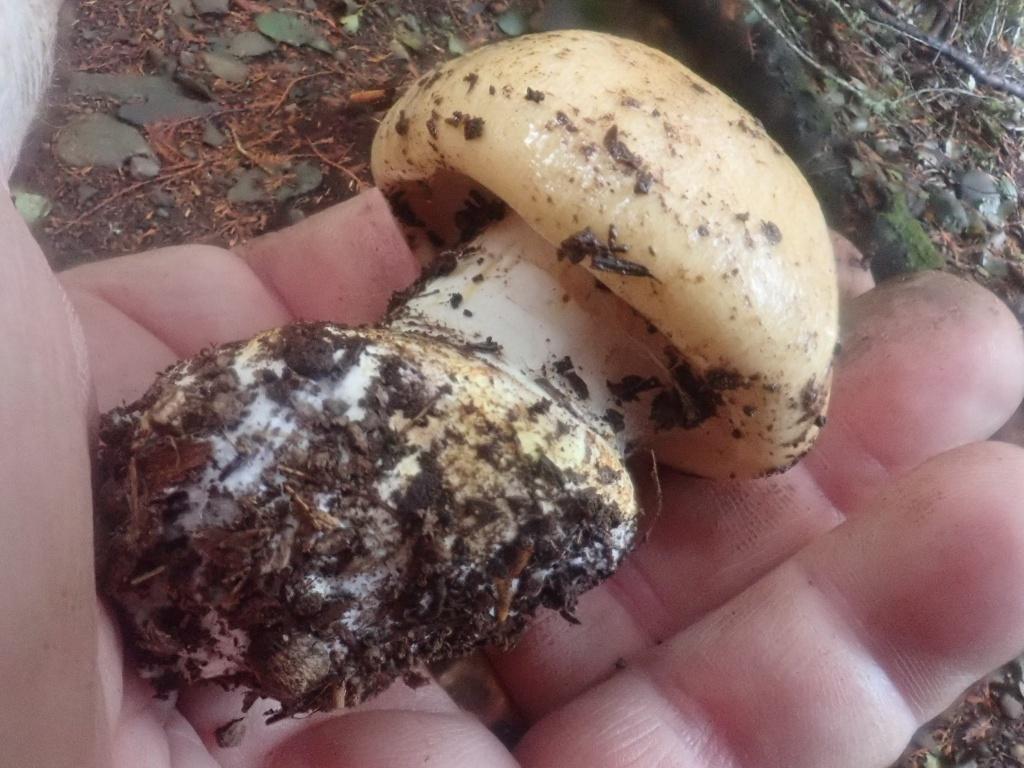
This robust yellow member of the Cortinarius family doesn't have a regular scientific name yet. For now, Mushroom experts are calling it Phlegmacium sp. 'Harrower37'. Bill Weir found it near Matheson Lake
The parrot mushroom (presumably named this for its billiant green colour) was originally described in Europe. We haven't found the sequence of the European species in Western North America yet, but we have found five related species. This one is called Gliophorus sp. 'psittacinus-PNW02' for now. Netted by Roanan DeMeyer at Metchosin Wilderness Park in November, 2025
Karen Dyke, a biologist working out of Nanaimo, came to Devonian Park in November and photographed a mushroom that turned out, after sequencing, to be our first BC iNaturalist record of Inocybe sp. 'sindonia-PNW24', a near-but-not-quite-the same relative of Inocybe sindonia.

Nature Metchosin 2025. Year in Review

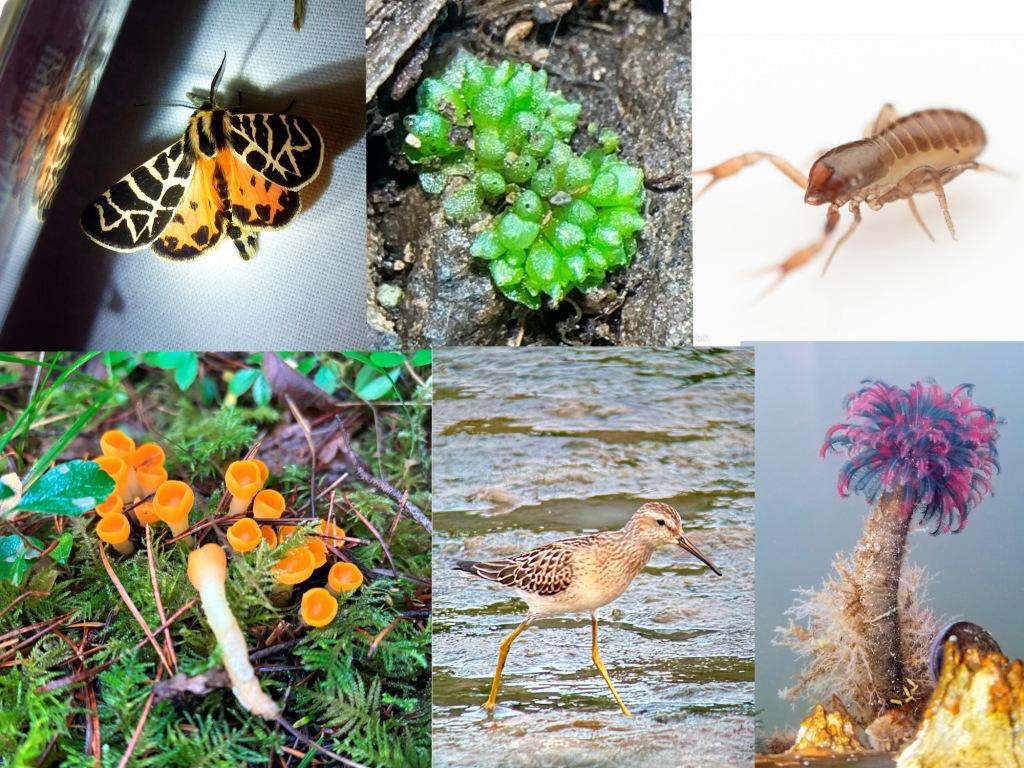
Some 2025 photos from iNaturalist observations. Images from upper left, clockwise: Nevada Tiger Moth by Moralea Milne; Texas Balloonwort by Nathan Earley; a pseudoscorpion by Thomas Barbin; Northern Feather Duster Worm by iNaturalist user ellery_mf; Stilt Sandpiper by iNaturalist user Dan Tyson; Stalked Orange-peel Fungus by Amanda Ray Garner. Photos used under Creative Commons license.

The Metchosin species count took a huge leap in 2025—about 450 new species were added, making 2025 by far the most productive year since the Metchosin Biodiversity Project (MBP) switched to iNaturalist in 2018. The current count of 4250 species in Metchosin may be the highest—at least among comparably sized municipal regions—in Canada.

The Metchosin records added in 2025 were culled from a pool of 11,000 iNaturalist observations made by 550 people and vetted by twice that many experts from all around the world. (To see the latest numbers, visit our database.)

Here’s a short review, broken down by category, of some of the species that were added to the MBP’s database in 2025:

Birds. If any group of Metchosin species should be approaching its upper limit, birds would be an obvious candidate. Still, a dozen new birds showed up in this year’s records. The expansion of MBP bird records has been mostly thanks to hosting the Rocky Point Bird Observatory and their skilled birders in our district. Our first Cassin’s Auklet (Ptychoramphus aleuticus) was sighted in 2024 but only added to the database this year. It’s a red-listed diving bird that lives on off-shore islands. The Virginia Rail (Rallus limicola), a large, comical bird that hangs around brackish marshes and is better known to people in Victoria and Saanich, popped by Metchosin in August. In the same month, an Eastern Kingbird (Tyrannus tyrannus) balanced on the top of a Metchosin Douglas-fir. The Stilt Sandpiper (Calidris himantopus), a long-distance traveller, usually migrates through eastern North America on its way from Arctic breeding grounds to winter feeding in South America, but a few of them make their way to the West Coast—as one did in Metchosin in 2025 (pictured).

Insects. More than half of the species added to the iNaturalist database in 2025 were insects. About 60 were hymenoptera—bees, wasps, flies, and ants. About 30 were coleoptera—beetles—and almost as many were arachnids (spiders, mites, and the like). But the real performers were the lepidoptera, the butterflies and moths—MBP had nearly a hundred new records in this order of insects. Three-quarters of these moths were thanks to Moralea Milne, a former Metchosin councillor and advocate of local biodiversity. When she died in 2018, Moralea left behind a trove of nature photos, many taken around her home along the Sooke Road. Libby Avis, a local moth expert, meticulously combed through all of Moralea’s lepidoptera photos, identified them, and added them to our database (see, for example, Moralea’s Nevada Tiger Moth, Apantesis nevadensis, in the picture above). Moralea was one of the MBP’s founders, and it was touching to see her legacy carried on in this way.

Vascular plants and mosses. While MBP does not add cultivated plants to the database, many plants that were introduced to Canada—deliberately or accidently—have learned to survive outside of cultivation, qualifying them to be included in our records. About a third of the 50 plants added for the first time to the Metchosin iNaturalist records in 2025 fall into this category. Some of these, because they cause harm to native ecosystems and displace native plants, might even be called invasives. Field peppergrass (Lepidium campestre) fits the invasive category. In contrast, the delicate Nodding Trisetum (Graphephorum cernuum) found in May by James Miskelly is one of our less common native grasses.

Mosses and liverworts. Among the twelve new Metchosin species in this category was the lovely, rare, and aptly named Texas Balloonwort (Sphaerocarpos texanus, see the picture). A BC bryologist commented that this find in Metchosin deserved “flashing strobe lights and international billing.”  

Fungi and Slime Moulds. About 75 species of fungi, lichens, and slime moulds were first added to the Metchosin records in 2025. Many in Metchosin will be familiar with the ubiquitous Orange-peel Fungus (Aleuria aurantia), but in 2025 INaturalist user argarner recorded the handsome Stalked Orange-peel Fungus (Sowerbyella rhenana, pictured).

The launch of the new BC Mycomap project in September, funded in part by the Metchosin Foundation, added a new slant to local work on the local fungi and slime moulds. Members of these phyla can be hard to identify all the way to species level. For many of them, it is essential to obtain sequences of an area of their genome known as the “fungal barcode.” BC has historically trailed US states south of the border in obtaining and publishing these barcodes. The Mycomap project’s goal is bring BC up to speed in this important effort. By the end of 2025, about a hundred people from all over BC had taken on the task of submitting vouchers for sequencing. Of the 10,000+ collections made, 4% have come from Metchosin. Leading contributors to the Metchosin vouchers include Simone Littledale, Karen Dyke, Bill Weir, Roanan DeMeyer, Tina and Ian Brown, and Kem Luther. When the results start to arrive in the middle of 2026, numerous new species will become part of the Metchosin count.

Marine Life. About 60 new species fall under the loose heading of “marine life.” These include seaweeds, barnacles, chitons, crabs, fish, molluscs, nudibranchs, amphipods (e.g., shrimp), sponges, and sea worms. One of the crabs was, unfortunately, the European Green Crab (Carcinus maenas), which has been spreading along the Southwest Coast of BC. A supercompetitor that displaces native crabs and damages crucial marine habitat, it arrived on the West Coast about 1990, and in 2012 a well-established population was discovered in the Sooke Basin. The Coastal Restoration Society has trapped and removed more than 600,000 of these crabs from Sooke and Clayoquot Sound. Discussions are taking place about what can be done to prevent their spread in Metchosin waters.
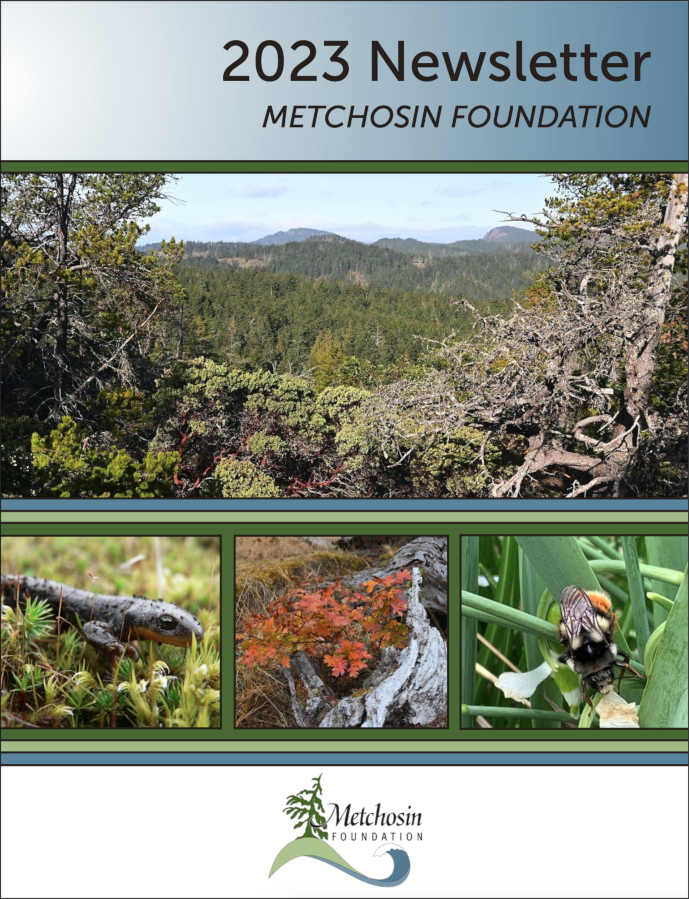
Metchosin Foundation 2023 Newsletter

The Metchosin Foundation has generously supported the work of the Metchosin Biodiversity Project over the last twelve years. In addition, the Foundation support multiple projects in Metchosin that align closely with the goals of the Metchosin Biodiversity Project.

The foundation has recently revived its annual newsletter. It tells about many of its current projects.

Many Metchosinites support the foundation and its work. For further information, please see their website.

Miskelly garry oak work recognized

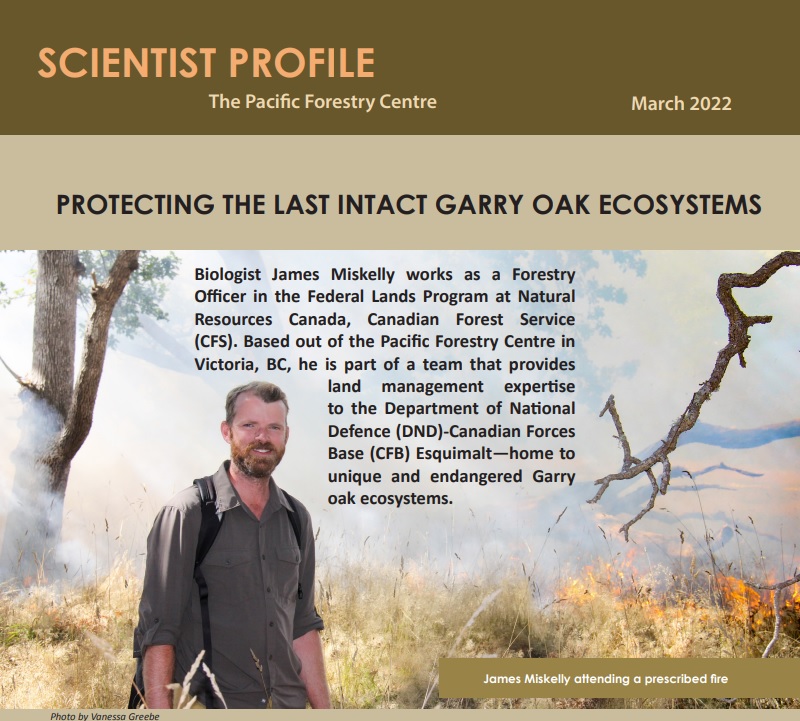
The work of Metchosin Biodiversity Project member James Miskelly on the DND Garry oak lands has been recognized in a recent profile from the Pacific Forestry Centre. Congratulation James! Click on image to read.

James regularly logs his Metchosin (and other places) natural history observations in iNaturalist. See some of his pictures and sightings here.

Metchosin Biodiversity

Welcome to the web site of the Metchosin BioBlitz and MycoBlitz. The team at the Metchosin Biodiversity Project sponsors the blitzes and publishes the results on these pages in order to:

  • Increase our understanding of Metchosin’s species and ecosystems.
  • Share natural history information with interested people.
  • Use this information to protect Metchosin’s species and ecosystems.

We started our work in 2011 with BioBlitzes and (a bit later) MycoBlitzes. Our most up-to-date inventories of Metchosin species are available in the Metchosin Biodiversity project of iNaturalist. By the end of 2025 we had catalogued almost 4250 species, from almost 33,000 observations made 1200 people. See the posts below for the latest totals. We encourage everyone interested in helping us to log their photographed Metchosin observations in iNaturalist. All of these observations will be reviewed and many will be moved into our iNaturalist database (Metchosin Biodiversity Project).

For more about the Metchosin Talk and Walk series, see the Talk and Walk pages. View a list of T&W speakers.

The Metchosin Biodiversity Project acknowledges the regular support of the Metchosin Foundation. The project is a member of IMERSS.